
Cracking Your Credit Score: What Really Matters
School is back in session. Thank heavens! My daughters start their 7th and 10th grade years this week.
I’m trusting that they’ll learn new skills; some they may never use like algebra and others that they’ll use daily – foreign language or even the English language.
What I don’t have trust in is that they’ll learn anything about managing money. Practical application of budgets, financial literacy, and credit is not on the roster for them and it likely wasn’t for you either.
So, school is in session for all of us here. Let’s talk about credit score and debt management.
You’re Not Your Credit Score — But Let’s Understand It Anyway
If the number on your credit report feels like it’s controlling your life, you’re not alone. Whether you’re applying for a mortgage, refinancing your car, applying for a new apartment lease, or even signing up for a new phone plan—your credit score seems to follow you everywhere.
And if yours isn’t where you want it to be? Cue the shame spiral.
“I just keep seeing my score go down.”
“I used to have a decent credit score.”
“I’m worried about my score. It’s depressing.”
If you’ve ever said those words out loud, or had the thought running through your head, you’re not alone.
Maybe you’re on the other side of that ‘depressing’ number and you have a sense of pride over your ‘excellent’ credit score. You too, are not alone.
But here’s the truth I want you to walk away with today: your credit score is not the whole story—and it’s not your final destination. You have power over it, not the other way around. Understand it better so that you can make decisions about how you use debt, and what you want to do with your score.
Let’s break it all down.
What Is a Credit Score, Really?
Think of your credit score as a grade—an estimate of how likely you are to repay borrowed money. It’s based on your past borrowing behavior, not your income, your net worth, or your intentions. The fact that you love Jesus? Doesn’t matter. You got good grades in school? Doesn’t matter.
First timer with a credit card? That matters.
Made late payments or missed payments? Matters.
Balance running near the limit of your credit card? Matters.
Scores typically range from 300 to 850 and are reported by three major credit bureaus: Experian, Equifax, and TransUnion. These bureaus are the ones that hold your credit report that has the details surrounding your credit use over the past several years. The most common scoring model is FICO, though VantageScore is also used. Your credit report won’t always share your credit score. Think of your report like your school transcripts – all the classes, with all the grades, missing assignments, etc. and your credit score is your GPA – a quick snapshot.
Want to see what’s on your report?
Go to AnnualCreditReport.com for a free report from each bureau, once a year. No strings attached. If you’re in a mode of wanting to improve your score I’d recommend setting up a calendar appointment with yourself. January pull Experian. May pull Equifax. September pull TransUnion. Repeat each year. You’re watching for errors on your report and want to work to get those resolved – you’ll also see that as time marches on things will fall off of your report, both ‘good’ and ‘bad’ things.
What Impacts Your Credit Score?
Your credit score is built from five key components, and each one carries a different weight. Here’s the breakdown, in order of importance:
🧾 Payment History (35%)
Have you paid your bills on time? One late payment can ding your score significantly. Read that again. A single late payment can reduce your score. Translation, one of the EASIEST ways to improve your credit score is to pay your bills on time, on or before their due date. Best way to set yourself up for success here? Autopayments. Nearly all ‘bills’ these days have the opportunity to make auto payments, and sometimes they incentivize you with a small discount or perk if you set up autopay.
I can’t skip saying that if you’re worried that you won’t have enough money in your account to cover that bill, so that’s why you don’t have it on autopay….you are likely overextended. Too many bills, friend. BUT, I’d rather you pay those when you can – even if late – than compromise paying for your rent/mortgage, groceries, or other priority expense that cares for you and your family.
💳 Credit Utilization (30%)
How much of your available credit are you using? If your credit cards are maxed out, your score is probably feeling it. Aim to keep usage under 30% to keep the credit score happier. My preference is that you’re paying off those suckers each month….that’s the best practice if you’re going to use a card. Otherwise, those interest rates – typically running at an average of 28% right now, but some well over the 30% mark are going to be a monkey on your back that you want to ditch ASAP.
Let’s break this down with some quick and easy math.
Credit Limit of $10,000
Credit Balance of $2,999
Utilization is just 29.99%
Credit Limit of $5,000
Credit Balance of $2,999
Utilization is 59.99%
🕰️ Length of Credit History (15%)
The longer you’ve had accounts open (especially in good standing), the better. Don’t rush to close old cards, in fact it may make sense to keep your ‘oldest’ card if you want to carry a credit card that you plan to payoff in full – AND you want to keep your credit score at the top of the charts.
That means that when you’re first starting out with credit, you don’t fare well in this category. Time is needed to prove your history with credit use. They’re watching you.
🆕 New Credit/Inquiries (10%)
Every time you apply for credit, it triggers a “hard inquiry.” Too many of these in a short time can temporarily drop your score.
Think about it, if you’re in a sticky situation and you go trying to open a bunch of credit cards – you smell like a sticky situation. Creditors will worry that you are in a position to not be able to repay timely or maybe at all. They’ll be less likely to lend to you OR what’s more likely…they’ll lend to you at a much higher rate to mitigate their risk and make a bunch of money off of you in interest.
📊 Credit Mix (10%)
Do you have a mix of revolving credit (like credit cards) and installment loans (like auto or student loans)? Lenders like to see that you can handle different types of debt. Again, this is a score that’s trying to tell how great you are with handling your debt – they WANT you to have more debt to prove that you can pay it back. This matters the least amount overall.
I would never advise someone to go take out a car loan or student loan to increase their credit score. But if you already have those, and they are reported on your credit report, it gives you a little boost.
All Debt Is Not Created Equal
Let’s talk types of debt—and how they affect your score:
 Revolving Debt
Like credit cards. High balances hurt your utilization and your score. Pay these down first. I can’t emphasize this enough; not just for your score’s sake…because I really don’t care too much about your score unless you’re getting ready to make a big debt purchase (like a house). Even then – there are ways to work around a lack of score with manual underwriting, not easy – but still possible.
Back to the credit cards. Those little plastic cards that you initially were just going to use to ‘build your credit’ or ‘in case of emergency’ have become little balls of fire that are destroying your finances.
Let me show you an actual client example of current debts, minimum payments and the amount of interest that is going to those companies for the convenience of borrowing their money.
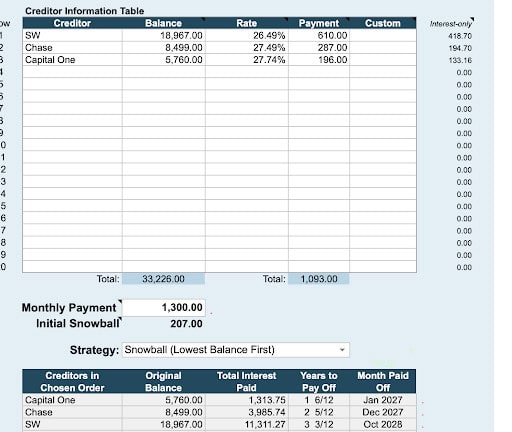
Time out to talk about wealth building.
Your income is one of your greatest assets. You can use it to invest in the stock market or mutual funds where you’ll average 10-12% return on your money over the long haul. Or you could choose to invest in investment property that gains equity and increases in value over time, perhaps while also bringing in passive income.
If most/all of your income is tied up in payments, revolving or installment debt – you have less money to put toward building your wealth. Do not max out your monthly income with payments to someone else. Pay your future self by investing.
⚠️ Collections/Charged-Off Accounts
These hit your score hard. Even paying them off won’t erase the damage right away—but it’s still worth doing. If you had a situation with lost income, hardship and you just plain old couldn’t pay your bill the creditor will send it to collections or charge it off. That’s a giant red flag to companies that they may not want to do business with you, for obvious reasons – they want to get their money back, and then some.
If you have collections on your credit report, they are there to stay. Prioritize paying off the ‘active’ items before you worry about cleaning up those collections. Still worth doing, it will improve your score – but it will still take time/distance from those charge offs to really clean it up.
If you’re in a position to pay off your collections, always negotiate. Collection companies are paying around 10% of the balance for your debt, then trying to collect 100% or more of it. You can often work to negotiate (sometimes over several phone calls) down to 50% of the balance.
Read about Kristi’s collections story here.
I know that you know this already, but I have to type it out loud. Please list out your debts, choose the method that you want to pay them off. Snowball, avalanche, stair stepper…and prioritize this payoff.
You can read more about debt payoff and credit cards here:
- Debt is a four-letter word: Debt Payoff Plan
- Young Newlyweds Payoff Debt of $35K
- Single Mom Superpowers: Eliminating Debt for Good
- How to use credit cards responsibly
📈 Installment Debt
Like car loans, personal loans, or mortgages. As long as you’re making on-time payments, these tend to have a more neutral or positive impact on your credit score. That doesn’t make them “good” it just makes them better than revolving credit. If you’re paying anything more than 7% interest on these…I want you to work towards paying these off sooner rather than later too.
Debt Payoff vs. Debt Consolidation: What’s the Difference?
You’ve probably heard of the snowball (smallest balance first) and avalanche (highest interest first) methods of paying off debt. My personal favorite is the stair stepper that combines both methods, grouping the debts into ‘steps’ by balance and then paying off the lowest balance step first – but the debt with the highest interest rate on that step. All work—but none are magic unless you change your habits.
Habit change is the TRUE hero of a debt payoff journey. Without it, many find themselves back into the very same cycle in a matter of years or even months. As a coaching team, the accountability provided to support habit change combined with strategies and support is our job – we take great pride in seeing how you shift your habits over time.
Now let’s talk consolidation. It sounds clean and simple—combine your debts into one payment.
🚫 Myths About Consolidation:
- “It will destroy my credit.”
Not necessarily. If done properly, it can help your credit in the long run. - “It’s a scam.”
Some companies are predatory. That’s why doing your research—or working with a coach—is key. - “It’s the easy way out.”
Nope. It still requires discipline. It’s a tool, not a shortcut.
Bottom line: Consolidation can help if your interest rates are high and you’re juggling too many payments—but it’s not for everyone, and is only recommended if you have no discretionary income to make a proper ‘snowball’ type aggressive effort toward your debt. AND you’re combining it with true habit change.
The Hard Truth (and the Hopeful One)
Let me be real with you: A credit score is just a reflection of your past behavior. It doesn’t define your future.
I once worked with a client who came to me with multiple credit cards maxed out, a score in the 500s, and a whole lot of shame. But she was ready to do the work.
We prioritized her payments, automated what we could, and shifted her mindset from “I’m bad with money” to “I’m learning to manage it.”
Fast-forward a year later: her score jumped 120 points—not because we gamed the system, but because she got intentional with her money.
I’ve been there too. In our own debt-payoff journey, my husband and I stared down $450K in debt, and we had great credit scores. Our credit or debt didn’t define us—our actions did, and those habits continue to serve us.
What Can You Do Today?
Here are 5 simple steps you can take right now:
- Pull your credit report at AnnualCreditReport.com. Maybe mark your calendar if you want to continue to keep tabs.
- List out your debts and sort them by balance and interest rate.
- Pick a payoff strategy that works for your lifestyle—snowball, avalanche, or stair stepper.
- Watch your credit utilization—can you bring a card under 30%? Lower?
- Book a free strategy call with a coach (hi, that’s me, Ashely, Erin or Courtney) to get clear next steps.
You’re More Than a Number
Your credit score matters if you want to make a big purchase in the next few years —but your daily choices, discipline, and mindset matter more. You’re not broken. You’re learning. And you don’t have to figure this out alone.
Ready to take control of your money—not just your credit score?
👉 Book a free call with me here
Let’s create a plan that puts you in the driver’s seat—for good, no schooling required.
Thank you for joining me on my journey to influence.


Sign up below to get a weekly email with tips, tricks, and truth about intentionality with your time, talent, and money.