
The Real Cost of Your Time: How to Prioritize What Actually Moves the Needle
“I just need more time.”
It’s one of the most common things said in conversations around business, finances, and life in general – that joke about needing more hours in the day that we say light heartedly, but secretly wish that we could put in a request somewhere.
But here’s the truth that doesn’t always get said out loud: More time isn’t the solution, and the request box is never going to show up.
Because without clarity and intention, more time just creates more space to stay stuck, or fill up with the ‘wrong’ stuff.
Full days don’t automatically equal progress. A packed schedule doesn’t guarantee results. And checking boxes all day can still leave things feeling…off.
That gap? It usually comes down to how time is being used and what it’s actually costing. This rings true for ‘personal’ or ‘work’ hours or tasks – we all want to make the most of our time in all arenas.

The Real Cost of Time (It’s Not Just Hours)
Time is easy to measure in hours, but that’s only part of the picture. Every hour carries a trade-off. Saying yes to something small often means saying no to something more important. Not always intentionally, but it happens. And I don’t know about you, but sitting smack day in the middle of mid-life and my distraction level is increasing.
Time spent:
- scrolling
- overthinking decisions
- handling low-level tasks
- avoiding uncomfortable conversations
Quietly replaces time that could be spent on:
- growing income
- improving financial clarity
- building stronger relationships
- taking care of health
- ________ things you really want to do
That’s opportunity cost, and it shows up whether it’s tracked or not.
Tools can absolutely help. There are great ones listed in 42 Favorite Recommendations to Save You Time. (backlink) But even the best tools can’t fix unclear priorities.
At some point, it comes down to decision-making.
Busy vs Productive (They’re Not the Same)

This is where things start to shift. Busy feels good. It feels responsible. It feels like progress. You’re doing some things, damnit!
But it’s not always productive.
Answering emails or texts all day? Busy.
Running errands? Busy.
Tweaking a website or content endlessly? Still busy.
But none of those guarantee forward movement, but we often ‘think’ that they are forward moving.
A helpful way to think about it:
Movement vs Momentum
Movement is activity.
Momentum is results.
A lot of time gets spent in movement because it’s comfortable. It’s familiar. It’s easier to check off. I know that you know what I mean. I am guilty of this too, crossing things off the list feels good – but truly, I should have less on the list, because they should be bigger, momentum-moving items.
Momentum usually requires more intention. Sometimes even a little discomfort, and often more time.
This is something that’s been broken down before in 4 Steps to Prioritize What Matters Most Time. Not everything deserves equal time, even if it feels urgent at the moment.
Time as a Budget
There’s a concept that tends to click pretty quickly with people. Time works a lot like money. Without awareness, it gets spent without intention. A simple time audit, even for a few days, can be eye-opening.
Nothing complicated. Just tracking:
- what’s being done
- how long it takes
- how it actually feels
Then grouping it into:
- growth or income-producing
- maintenance
- time leaks

Most people are surprised by what shows up. Not because of laziness, but because it’s never been looked at closely. Similar insights happen when we track spending for a month. AND I just want to call out that it’s okay to not be 100% in the growth phase. You are absolutely going to have maintenance and time leaks, but the amount of time you spend in these is important.
The same way budgeting brings clarity to finances, a time audit brings clarity to daily life.
The Buy Back Rate (A Different Way to Look at Time)
One of the most practical ways to evaluate time comes from the book, Buy Back Your Time by Dan Martell. It was my favorite read of 2023.
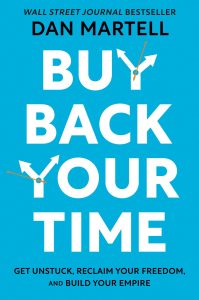
The concept is called the buy back rate.
The idea is simple: assign a dollar value to time based on your current income or income goals.
Here’s the basic formula:
Annual income goal divided by 2,000 hours; that’s assuming 40 hours of work per week, for 50 weeks of the year. If you don’t work 40 hours a week, or take more than 2 weeks off, adjust accordingly.
For example:
$100,000 per year divided by 2,000 hours equals $50 per hour.
That number becomes a reference point. Spending time on tasks worth less than that rate starts to look different through that lens.
Things like:
- admin work
- over-editing
- doing everything manually
- managing every detail personally
These don’t just take time, they limit the ability to focus on higher-value work. The pushback that often comes up is around affordability. “I can’t afford to outsource right now.”
That may be true in some cases, but the bigger shift is thinking differently about time first. The awareness comes before the change. AND if you can start moving more of your activity into the high value, high outcome work and simply spend less time on the other tasks – you’ll make more…and perhaps afford to be able to hire out sooner than you think.
Story Time
Less than a year into my own entrepreneurial journey, I was making some money – but not rolling in it by any means. I was still working full time, a busy household and growing my business. I wasn’t willing to sacrifice more time away from my family – already dedicating two evenings per week, Sunday afternoons, and early mornings to the effort.
My time was transitioning to using that dedicated time to clients, not admin work. I hired my first virtual assistant to work on putting the blog into production, creating some social graphics, and scheduling emails. These were not revenue producing activities for me, unlike coaching calls. They were however, important for me to stay consistent with as they were part of my long term online business plans. So, I bought back my time for about 10 hours a month.
And, although I’ve switched up VA’s a handful of times over the years – I’ve remained consistently with keeping these tasks (and now a few more) off of my plate and in the hands of a capable VA. Shout out to Jaie who put this blog – and all of the others for the past 1+ year into production.
What Actually Moves the Needle
Once time has a clearer value, priorities become easier to sort.
A couple of simple questions can help you make key decisions.
- Does this contribute to income, relationships, or health?
- Does this fit the current season of life or business?
- Is this something that only I can do? (don’t get stuck here…you’re going to want to say yes – but it’s not yes as often as you think)
If the answer is no, the task likely needs to be reduced, simplified, or eventually handed off.
This builds on the structure already shared in 4 Steps to Prioritize What Matters Most Time (backlink to blog), but adds another layer of clarity.
Not everything needs to be done. And definitely not all at once.
The Hidden Time Traps
Even with good intentions, there are patterns that quietly take over.
On the personal side:
- saying yes too often
- avoiding necessary conversations
- trying to manage everything alone
On the business side:
- creating content without a clear strategy
- spending too much time on low-impact tasks
- getting stuck in perfectionism
There are ways to simplify, especially when it comes to content. That’s covered in 10 Time Saving Content Creation Tips for Busy Entrepreneurs.
The same principle applies across the board. Simple tends to scale. Complex tends to stall. Make it easier on yourself.
We don’t want your business card, we want a real conversation. Networking feels best to us when it’s organic, personal, and rooted in genuine curiosity rather than pitching. We’ve walked into rooms feeling intimidated, but we’ve learned that thoughtful questions and genuine listening create far more meaningful connections. Relationships over transactions, every time, and finding a community that truly understands and supports both you and your business makes all the difference.
How to Start Buying Back Time
This doesn’t require a full reset or a perfectly planned system. Small, intentional shifts go a long way.
Start with:
- removing what isn’t necessary right now
- simplifying where things feel overly complicated
- creating repeatable processes
- gradually handing off what doesn’t require direct involvement
This can apply to both business and home life. The goal isn’t to do everything independently. It’s to create alignment with what matters most – and truly moves the needle toward your goals.
Time, Money, and Energy Work Together
One final piece that often gets overlooked; time doesn’t operate on its own.
Financial stress can increase workload.
Low energy can slow everything down.
Lack of systems can create constant repetition.
These areas are connected.
Addressing one without looking at the others tends to limit progress.
Vulnerably, I had a ‘straw that broke the camel’s back’ moment a couple of months ago where the overwhelm hit me amidst a busy business, active family, and growing task list. My own mental and emotional health was feeling compromised.
I was forced to make some edits so that I could function better. You can read more about that straw and camel situation in this social post.

It’s Not About More Time
At the end of the day, this isn’t about squeezing more into the schedule. It’s about making better decisions with what’s already there.
When time aligns with priorities, things start to feel different; progress becomes clearer, decisions feel easier, and energy is used more intentionally.
Not because there’s more time, but because it’s being used differently.
Thank you for joining me on my journey to influence.


Sign up below to get a weekly email with tips, tricks, and truth about intentionality with your time, talent, and money.