
Money Mindset Makeover: The Real Reason Your Budget Isn't Working - and How to Fix It

Most people who come to me have already tried budgeting.
More than once.
The spreadsheet exists. The app is downloaded. The New Year’s resolution was made. And yet -here they are, three weeks later, three months later – or sometimes three years later; off the rails again, feeling like they’re the problem.
They’re not. The budget is.
Not because they chose the wrong app or used the wrong method. But because no budget built on willpower alone survives contact with real life. And almost every budget I see – before coaching – is built on exactly that: willpower, restriction, and a quiet belief that if you just had more discipline, this would work.
So before we talk about spreadsheets, apps or other methods, let’s talk about what’s actually going on.
The real reason your budget keeps failing
Here’s what nobody tells you: budgeting is 20% math and 80% mindset, another way it’s often shared is that it’s 20% head knowledge, and 80% behavior.
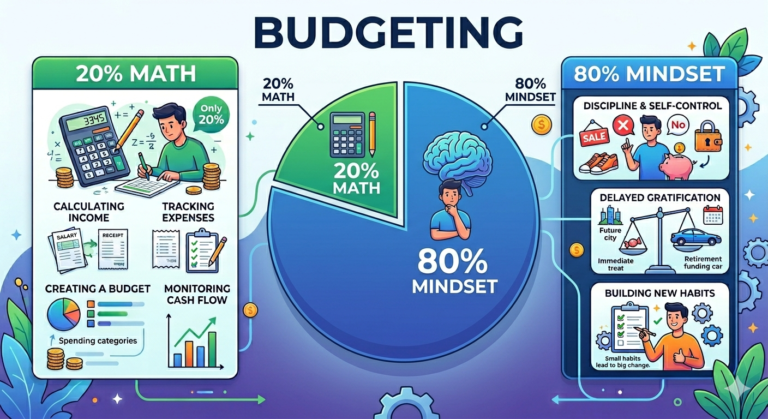
You can have the most beautifully organized budget accounting for all possibilties in the world, and it will still fall apart if you haven’t addressed the beliefs, stories, and emotional patterns running underneath it.
We see this every single week inside my coaching practice. Smart, capable people – people who manage teams, run businesses, raise families – who cannot seem to make a budget stick. And it’s never really about the numbers or the math.
- It’s about the story they learned about money growing up.
- It’s about what they believe they deserve.
- It’s about whether they believe change is even possible for the
Before James and I tackled our $450,000 in debt, I had to do this work too. I had to look at my own money stories – where I learned to spend, why I avoided certain conversations, what I believed about “people like us” and money. That inner work is what made the outer strategy stick.
So let’s name the three mindset blocks I see most often – and how to move through them.
Mindset Block #1: Deprivation thinking
This is the “I can’t have anything” budget.
It’s built around restrictions. Every category is slashed to the bare minimum. Fun money? Gone. Eating out? Never. It feels virtuous for about 11 days. Then you’re exhausted, resentful, and standing in Target (or on the couch with the Amazon app) buying things you don’t need because your nervous system needed some kind of relief valve.
The fix: build permission into the plan.
A budget that works long-term is one you actually want to live inside. That means fun money is a line item – not a reward for being good. It means your coffee, your gym membership, your house cleaning service, your weekend farmers market habit can stay. You just decide on the number in advance, with intention.

A budget isn’t a punishment. It’s just a plan. And a good plan has room for things that bring you joy.
Mindset Block #2: All-or-nothing thinking
This one is sneaky because it sounds like high standards initially. But what it really looks like is: “Well, I already blew it on Thursday so the whole month is ruined.”
Sound familiar?
All-or-nothing thinking turns one overspend into a full spiral. One unexpected car repair becomes proof that budgeting doesn’t work for you. One hard month becomes evidence that you’ll never get ahead.

The fix: treat your budget like a flight path, not a tightrope.
Planes go off course all the time. That’s not a crisis – that’s just flying. The autopilot corrects, you make a small adjustment, and you keep going. Your budget works the same way. Miss a week? Correct and continue. Overspend in a category? Move money around, note it, keep going.
Progress over perfection. Always.
Mindset Block #3: Shame spirals

This is the one nobody talks about out loud, but almost everyone carries.
It sounds like: “I should know better by now.” Or: “Everyone else seems to have this figured out.” Or the classic: “I make decent money – why is this so hard?”
Shame makes you avoid the budget, because looking at it confirms the story you’re afraid is true about yourself.
The fix: separate your worth from your numbers.
Your bank balance is not a report card on your value as a human being. It’s data. It’s information. It tells you where you are right now so you can decide where you want to go. That’s all. That’s it.
When we work with clients, one of the first things we do is create emotional safety around money – because you cannot think clearly about something you’re afraid to look at or talk about.
Now, the practical fix: a budget built for real life
Once we’ve cleared the mindset blocks, the practical stuff actually works. Here’s the framework I use with clients – and the same one James and I have used for years.
Step 1: Give every dollar a job
This is the foundation of zero-based budgeting. You start with your monthly income and assign every dollar to a category before the month begins – not after. Not as a reaction to what you already spent, but as a deliberate decision about where your money will go.
Income minus expenses equals zero. Not because you’ve spent everything, but because every dollar has a purpose: bills, savings, debt payoff, fun, and everything in between.
The power here? You stop making financial decisions by default and start making them on purpose.
Step 2: Build in a “life happens” fund
One of the fastest ways a budget falls apart is unexpected expenses – and unexpected expenses are basically just regular life. The car will need something. The kids will need something. The dog will need something.
Build a sinking fund for irregular expenses. Even $50 a month set aside for “life happens” costs will keep a surprise repair from derailing your entire plan. Depending on your needs this might be an emergency fund plus a few targeted sinking funds.
Step 3: Do a monthly budget review
At the end of every month, sit down for 15–20 minutes and look at what happened vs. what you planned. Not to judge yourself – but to learn.
What categories were too tight? What surprised you? What felt good? Use that information to build next month’s plan. Your budget should evolve as your life does, no month will look the same – and that’s okay, it’s expected!
This is also one of my favorite tools for couples – a monthly money meeting removes the ambiguity, the blame, and the “you spent what?!” moments because you’re looking at the same information, together, with curiosity instead of frustration. Check out this free guide: Couples & Money Workbook
Step 4: Automate what you can
Willpower is a limited resource. Automation is not. Set up automatic transfers for savings, debt payments, and sinking funds so the important stuff happens before you even have a chance to redirect it. Remove the decision from the equation wherever possible.
What "working" actually looks like
I want to set realistic expectations here, because this is where a lot of people quietly give up.
A budget that “works” is not a budget you follow perfectly every single month.
A budget that works is one you keep coming back to.
It’s the one you adjust instead of abandon. The one you open even when you’re afraid of what you’ll see. The one that, over time, starts to feel less like a constraint and more like a tool you actually trust.
That’s the goal. Not perfection – but consistency.
The best budget isn’t the most detailed one. It’s the one you’ll actually use.
A note on mindset vs. method
There are a lot of budgeting methods out there – zero-based, 50/30/20, cash envelopes, apps, spreadsheets. I’m not here to tell you one is the only right answer.
What I will tell you is this: the method matters far less than your relationship with money. If you’ve tried three different systems and none of them have stuck, the problem probably isn’t the system. You following me?
That’s where coaching changes everything. When you do the inner work alongside the practical strategy, things start to shift – sometimes faster than you’d expect.
If you’re ready to stop white-knuckling your finances and start building a plan that actually fits your real life, we’d love to help.
Schedule a call here and let’s talk about where you are and where you want to go.
Thank you for joining me on my journey to influence.


Sign up below to get a weekly email with tips, tricks, and truth about intentionality with your time, talent, and money.