
The Ultimate Guide to Personal Finance Coaching

You make decent money. You’re not irresponsible. And somehow you’re still stressed every time you check your bank account.
Sound familiar? You’re not alone, and you don’t need another budgeting app or a lecture about your coffee habit. What you actually need is a plan, and someone in your corner making sure you stick to it. That’s personal finance coaching, and this guide covers everything you need to know before you get started.
Quick answer: Personal finance coaching is one-on-one, ongoing support for the habits, systems, and behaviors behind your money, including budgeting, debt payoff, cash flow, and savings. Unlike a financial advisor, a financial coach doesn’t manage investments. At Journey to Influence, our core offering is a one-year engagement starting on a sliding scale from $249/month, with a shorter minimum 90-day package also available at a different rate.
In this guide:
- What Is Personal Finance Coaching?
- Financial Coach vs. Financial Advisor
- Who Needs a Financial Coach?
- What Does Financial Coaching Actually Cover?
- How Does Financial Coaching Work?
- How Much Does It Cost?
- What Results Can You Expect?
- Why I Coach the Way I Do
- How to Choose a Financial Coach
- Is Coaching Right for You?
- FAQ
- Your Next Step
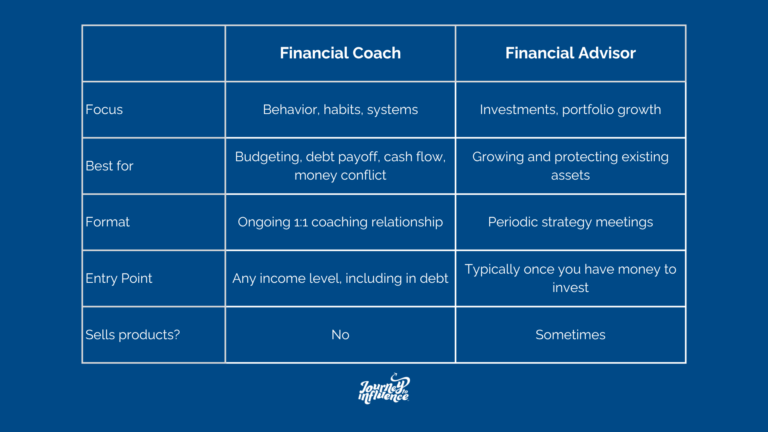
These aren’t competing roles, they’re sequential ones. Most people need a coach before they need an advisor, and a lot of our clients go on to work with an advisor once coaching has gotten their day-to-day finances under control.
What Is Personal Finance Coaching?
Personal finance coaching is ongoing, one-on-one support for the habits and systems behind your money, not just the numbers on the page. A financial coach helps you build a real budget, pay off debt strategically, manage cash flow, and change the behaviors that keep derailing your progress. You might hear it called budget coaching or money coaching too, it’s the same idea by different names.
A coach doesn’t hand you a spreadsheet and wish you luck. You meet regularly, build a plan together, and get held accountable to it. When life throws a curveball (and it always does), the plan gets adjusted instead of abandoned.
A budget can tell you where your money went last month. Coaching helps you understand why it keeps going there, and builds a system so it stops happening. That’s the difference between information and actual change.
Financial Coach vs. Financial Advisor: What's the Difference?
Personal finance coaching is ongoing, one-on-one support for the habits and systems behind your money, not just the numbers on the page. A financial coach helps you build a real budget, pay off debt strategically, manage cash flow, and change the behaviors that keep derailing your progress. You might hear it called budget coaching or money coaching too, it’s the same idea by different names.
A coach doesn’t hand you a spreadsheet and wish you luck. You meet regularly, build a plan together, and get held accountable to it. When life throws a curveball (and it always does), the plan gets adjusted instead of abandoned.
A budget can tell you where your money went last month. Coaching helps you understand why it keeps going there, and builds a system so it stops happening. That’s the difference between information and actual change.
Who Needs a Financial Coach?
Financial coaching is most effective for three types of people: individuals stuck in a paycheck-to-paycheck cycle despite a decent income, couples in conflict over money, and small business owners whose personal and business finances have blurred together.
Individuals
Individuals who feel like they’re doing everything right (good job, decent paycheck) but can’t figure out why they’re not getting ahead. Usually there’s no real debt plan, no actual budget, and a lot of quiet financial anxiety hiding behind a life that looks fine from the outside.
Couples
Couples where money has become the thing you fight about, or don’t talk about at all. One partner is usually carrying more of the mental load, and the conversations have gone from productive to tense. Coaching gives you a shared plan and a neutral third party to work through it with. If you want a head start before your first session, 5 Essential Money Conversations for Couples to Build Trust is a good place to begin.
Small Business Owners
Small business owners whose personal and business finances have started to blur together, or who are ready to build real financial systems instead of managing everything by feel. For that side of things, see our small business coaching page.
If you saw yourself in any of those, that’s usually a pretty good sign. Not sure which camp you’re in, or just want a quick read on where you’re starting? Take the free Money Mindset Score quiz to find out before you book anything.
What Does Financial Coaching Actually Cover?
Typically, financial coaching covers budgeting, debt payoff strategy, savings systems, cash flow management, goal-setting, and accountability. Here’s what that looks like in practice:
- Budgeting. A real spending plan built around your actual life, not a generic template. If your budget keeps falling apart, Money Mindset Makeover breaks down why.
- Debt payoff strategy. A clear plan for what to pay off first and how. My husband James and I paid off $450,000 in debt in 18 months using this exact approach, and it’s still the backbone of how I coach.
- Savings systems. Emergency funds and savings habits that don’t rely on willpower, because willpower runs out.
- Cash flow management. Making sure the money is actually there when the bills hit, not just in theory.
- Goal-setting. Connecting your money to the life you actually want.
- Accountability. Someone checking in so the plan doesn’t quietly fall apart by week three.
Personal finance is personal. This isn’t investment advice and it’s not a cookie-cutter template. It’s your numbers and your life, mapped out with someone who’s actually paying attention.
How Does Financial Coaching Work?
Most financial coaching follows a similar arc: an initial consultation to understand your situation, goal-setting, building a customized budget and debt payoff plan, and then ongoing sessions for accountability and adjustments as life changes. The exact structure, session frequency, and tools vary by coach.
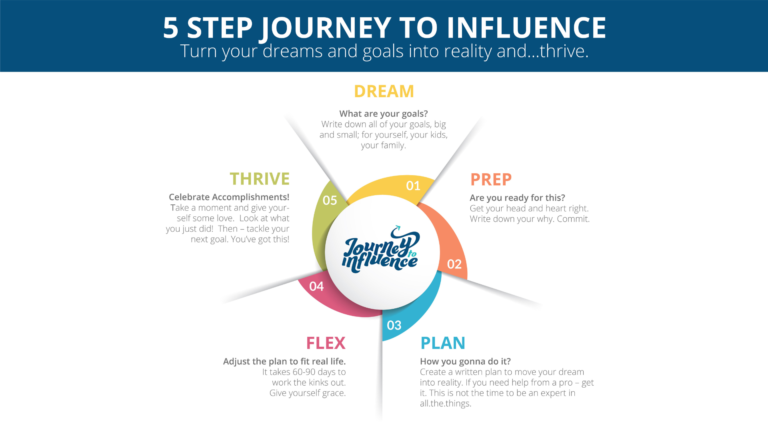
At Journey to Influence, we use our own five-step framework: Dream, Prep, Plan, Flex, Thrive.
- Dream. Get clear on what you actually want your life to look like. Coaching without a destination is just budgeting, and budgeting alone rarely sticks.
- Prep. Get honest about where you’re starting: income, debt, spending, savings, no judgment. This step is as much about prepping your head and heart for change as it is the numbers, since the mindset shift is what makes the logistics stick.
- Plan. Build your actual roadmap: budget, debt payoff order, savings targets, timeline.
- Flex. Adjust the plan together when life happens, instead of throwing it out.
- Thrive. Once habits are automatic and the plan is working, coaching shifts from putting out fires to building real momentum. It’s also about celebrating the milestones you hit, reflecting on how far you’ve come, and then setting the next goal and starting the process again.
Coaching with us happens through one-on-one video calls, a mid-month check-in, and ongoing support in between so you’re never sitting on a question for a month. It’s a full year of consistent support, not one session and a PDF you never open again. We do life together.
How Much Does Personal Finance Coaching Cost?
Personal finance coaching at Journey to Influence starts on a sliding scale from $249 per month for our core one-year package, with your exact investment depending on your income, the complexity of your situation, and the coach you work with. A shorter minimum 90-day package is also available at a different rate, and a lower-cost option exists through the Your Money Your Goals curriculum.
Good financial help shouldn’t be out of reach for the people who need it most, so we’d rather just tell you the number than dance around it. Your exact investment is confirmed on your free call.
What Results Can You Expect From Financial Coaching?
Clients of financial coaching typically report getting out of debt, aligning with their spouse on money decisions, and feeling less anxious about their finances day to day.
We have 40+ five-star Google reviews, and the themes repeat: families who rebuilt their finances from scratch, couples who learned how to talk about money without it becoming a fight, and business owners who finally understood where their money was actually going.
Results depend on where you’re starting and how consistently you show up, but the pattern holds. Clients leave with a system, not just a plan, and a system is what actually sticks.


Why I Coach the Way I Do
I didn’t come to this work from a textbook. My husband James and I paid off $450,000 in debt in 18 months, and it wasn’t glamorous. It was spreadsheets at the kitchen table, hard conversations about spending, and a lot of months where the plan felt slower than we wanted it to.

What got us through wasn’t willpower. It was a system, and having to actually show our numbers to each other instead of avoiding the conversation. That’s the exact thing I now build with every client, whether you’re doing this solo or with a partner. I’m not coaching you from theory. I’ve sat exactly where you’re sitting. And every coach on our team has been in the same seat too, each one started as a client before they ever coached someone else.
How to Choose a Financial Coach
The right financial coach comes down to their process, their own track record with money, whether their personality and style actually mesh with yours, and whether their format fits how you actually need support. Here’s what to ask before you hire anyone.
What’s your process? A coach without a clear framework is just winging it alongside you. Ask what happens in session one, how goals get set, and how progress gets tracked over the course of the engagement.
Have you done this yourself, and helped others do it too? Coaching from lived experience is different from coaching from a textbook. Ask if they’ve navigated debt payoff, a tight budget, or a money conflict in their own life, not just studied it, and ask how many clients they’ve actually walked through the same thing.
How much contact do I get between sessions? A once-a-month call with nothing in between makes it easy for a plan to quietly fall apart. Look for a coach who offers real accountability, not just a monthly check-in.
What’s the actual cost, all in? Get the full number up front, including how long the engagement runs and what happens if you need more or less time than expected.
Do you work with people like me? A coach who’s worked with individuals, couples, and business owners will understand the specific dynamics of your situation, whether that’s a spouse who isn’t on board or business and personal finances that have blurred together.
Do our personalities click? You’ll be talking honestly about money for months, so it matters whether their style feels like a fit, direct or gentle, structured or flexible. Trust your gut on the first call.
What happens if it’s not a fit? A good coach will tell you honestly if they’re not the right match instead of taking you on anyway.
If a coach can’t answer these clearly on a first call, that’s worth paying attention to.
Is Personal Finance Coaching Right for You?
Here’s the quick gut check.
Good fit if you:
- Are motivated to change something, even without knowing exactly where to start
- Are open to accountability and honest conversations about money
- Want lasting habits and systems, not just a one-time answer
- Are willing to invest in help to get there faster
Probably not a fit if you:
- Want investment or portfolio advice (that’s a financial advisor’s job)
- Want a quick fix with no ongoing involvement
- Aren’t ready to look honestly at your numbers yet
Frequently Asked Questions
Our core offering is a one-year package, since real financial change takes sustained support, not a single session. A minimum 90-day package is also available if a full year isn’t the right starting point.
No. Financial coaching focuses on budgeting, debt payoff, cash flow, and the habits and systems behind your money. Financial advisors manage investments and sell financial products.
Plenty of clients start solo, even when money is a shared issue. We help you navigate that conversation, and many spouses join once they see the plan taking shape.
Journey to Influence uses a sliding scale starting at $249 a month for the one-year package, with a shorter 90-day option available at a different rate. Your exact investment is confirmed on your free call.
Sessions happen over video call, so clients are served anywhere, plus in-person availability for local clients in the Portland and Clackamas, Oregon area.
If you’re in the Portland or Clackamas, Oregon area, Journey to Influence offers local, in-person coaching in addition to video sessions. Outside that area, coaching happens entirely over video, so location isn’t a barrier either way.
For people who follow through on the plan, yes. Clients typically see results in debt payoff, cash flow clarity, and reduced financial stress, backed by 40+ five-star Google reviews.
Your Next Step
Remember that feeling from the top of this guide? Decent income, no real reason to be stressed, and stressed anyway? That feeling doesn’t fix itself. It just keeps showing up, month after month, until something changes.
Something changing doesn’t require you to have it all figured out first. It just requires one honest conversation and a plan built around your actual life, not a template. On that free call, we’ll talk through where you’re at and whether one-on-one coaching with me or with someone on my team makes sense. If it’s not the right fit, we’ll tell you that too.
That’s what we do. James and I lived it before I ever coached anyone through it, and every coach on our team has too. You don’t have to keep white-knuckling it alone.
Schedule your free call and let’s figure out your next step together. Or if you’re not quite ready to talk yet, take the Money Mindset Score quiz and start there.